My Grandfather
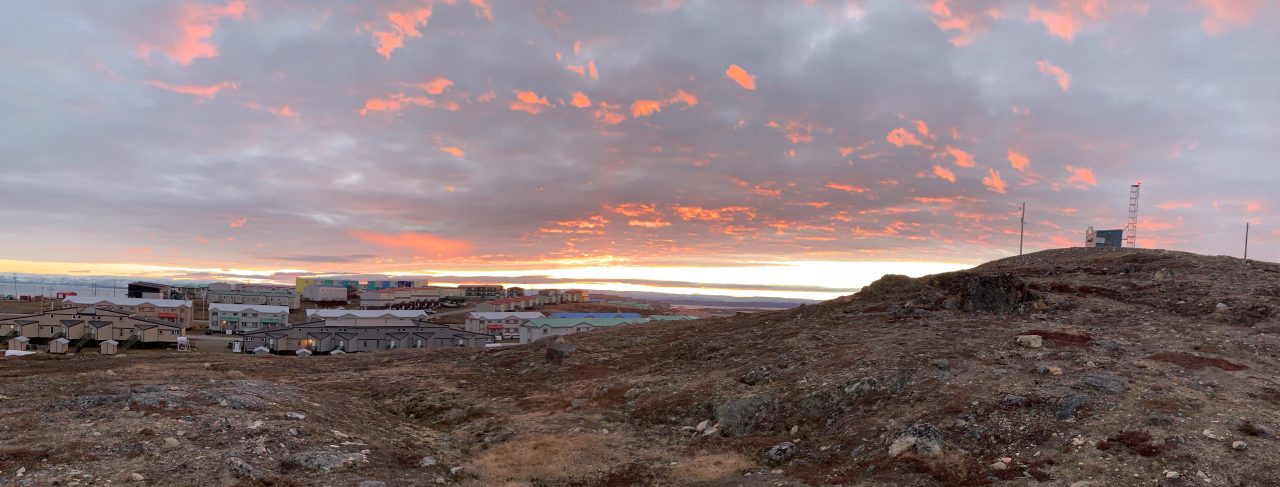
I grew up in Nunavut in a small high Arctic community called Igloolik where our family was close-knit. My paternal grandfather, Noah Piugaattuk, was the eldest person in the community at the time and people would call on him for advice, to learn about the Inuit history and to understand the impact Inuit experienced as a result of being colonized.
My grandfather remembered stories told to him about life before contact and he recalled some of the first non- Inuit who started living among the Inuit when he was a young boy who was becoming a young man. In fact he once guided a missionary named J. H. Turner, called Mikinniqsaq by the Inuit, to the Nattilik area in the Qitirmiut region in the late 1930’s to the early 1940’s where the last Inuit to be contacted by the outside world were living.
His stories were rich and he used traditional terms that were no longer being used. I recall on many occasions Louis Tapardjuk and other researchers coming to his house to record interviews. I would sit quietly next to my grandmother and listen to the stories he shared. These numerous interviews are archived at the Nunavut Research Center in Igloolik.
At a young age I was already noticing the traditional language my grandfather was using and this ignited in me an interest in learning how language is passed on from generation to generation.
My Father
My late father, Japeth Palluq, learned his traditional and language skills from his father. On my grandfather’s insistence, after I had left the community to complete my high school education in Iqaluit, my father moved his family out of the community to live in an outpost camp for many years. My younger siblings were brought up in a traditional Inuit life where survival depended on the animals and the environment.
My grandfather had seen the negative impacts on family and social values after families were moved from their traditional camps into the communities and insisted that he wanted to see my younger siblings grow up with strong family values without being distracted by new and emerging behaviors that disrupted the strong family ties.
Before I left for Iqaluit, Nunavut, to attain my high school diploma, my father made sure that I was well grounded in my language. Just as he learned his traditional terminology from his father, he did everything he could to pass it on to me.
Sometimes out of the blue he would say to me, “Panik, ‘niiqquluktuq’ qanuq tukiqarasugiviuk?” meaning, “Daughter, what do you think ‘niiqquluktuq’ means?” Anytime he would ask me such a question it was always about a word I had never heard of before. I would think about the word, try to break it down and I would provide him with an answer.
Sometimes he would chuckle, not that he was making fun of me, but because his little laughs were from being proud of me for trying to figure it out, or maybe my answers were down-right funny! But in doing these exercises with me he made sure that I had thought about the word in a way that I would remember and then he would tell me what it meant.
This way he ensured that all that he was teaching me would stay with me in the future. At times he was very blunt and he would tell me, “Panik, tammaravit!” meaning, “Daughter, you said that wrong!” He then would tell me that if I say it in this particular way I would be correct.
As he was teaching me about terminology and how to speak properly he did so in different ways, both softly and in a loving manner and sometimes using a more blunt and harsh tone, but always in a way that I would learn and keep my language.
My father was a strong leader in our community of Igloolik with deep roots in Inuit culture and traditions. He was one of the cultural and linguistic leaders. He learned from his father the traditional Inuktut including terminology that is no longer used in our modern lives. Even people older than he was would call on him about words that they themselves had forgotten.
He gave me a very strong grounding and encouraged me as I pursued my work in the field of language learning and teaching. He continued to teach me from time to time about traditional terms right up until he passed away in April 2011.
My Grandmother and Aunt
My late maternal grandmother, Sipporah Innuksuk and aunt Leah Otak were also insistent that I speak properly in their company.
They did not teach me in the same way as my father, but the stories they shared with me, together with keen observations about my responses, always kept me very aware of my speech.
They too were quick to correct me if I made any mistakes and I was always conscious to not make the same mistake twice.
In our language there are four possible suffixes following verb roots. This is because verb roots may end with a vowel, a ‘k’, ‘t’ or ‘q’. It is because of the different verb roots the post-base meaning ‘want’ is written in four different ways taking the forms –juma- following vowels, -guma- following /k/ endings, – tuma- following /t/ endings and –ruma- following a base ending in /q/. With some dialects and in the younger generations the /t/ suffixes are being dropped and replaced with the /k/ suffixes.
My grandmother insisted that I continue to use the /t/ endings and suffixes.
People my age and sometimes people even older than I am who no longer use these endings and suffixes would either say they do not understand me or that I am speaking like the Elders or in an ‘ancient’ way. I did notice though that some younger people that grew up with their grandparents or in outpost camps were still using these endings and suffixes.
My grandmother also insisted that we use our traditional relationship terms in our immediate and extended family. Traditionally people within a family would not call each other by name but rather by relation.
Among siblings there are four terms, angajuk for older sibling of the same sex, nukaq for younger sibling of the same sex, anik for brother of a female and najak for sister of a male. I have two older sisters and I call our eldest sister angajutaaq and the other angajuk.
If one is from a large family these four terms are all used with descriptive endings to differentiate one sibling from another. For example, if a male has many sisters he may call them najak (sister), najakuluk (sweet sister), najaralaaq (little sister) and so on.
These relationship terms extend to paternal and maternal aunts and uncles, cousins, in-laws, up to great-great grandparents.
My grandmother’s insistence that we use these terms also helped make our close knit family even more tightly connected. Today more and more families are calling each other by name and not using these terms anymore but I make sure that my four sons never call each other by name but by relation and always make sure to use the relationship terms when I introduce them to any of our extended family members.
Cultural naming is similar to the way Inuit use traditional kinship terminology. When a child is named after a relative who has passed on, the spirit of the person is believed to pass on to the child and the child will be regarded and addressed as the person s/he is named after.
I have five sisters and I was the only daughter my father called ‘daughter’. He addressed my sisters with the name of the relation they were named after. Starting from the eldest to the youngest he addressed them as, ningiuq (grandmother), najak (sister), ajak (aunt), anaana (mother) and illuq (cousin).
In so doing, my grandmother helped us learn about our family history and to remember the relatives who had passed on.
Another way in which my grandmother taught me, one that my father could not, was by teaching me different ways of skin preparation, pattern cutting and making clothing.
My arnarvikuluk, my aunt, who was also taught about proper language use continues to teach me to this day. She is the Manager of the Oral History Project with the Arctic College in Nunavut and documents traditional terminology.
We have lengthily discussions on issues we are facing in our communities today about language use, loss, shift, and deterioration. Anytime she notices the improper use of terms, suffixes and endings by the speakers of her community in Igloolik, she tells me, providing me with the correct use.
One example is the difference between the verb endings –guni and –pat. They both mean ‘if she/he/it’ but when using –guni the context of the sentence stays with the third person and if a –pat ending is used the context can change to the first or second person. Today we hear young people only using the –guni ending for the different contexts.
My aunt also passes on to me anything my grandmother may have corrected in her language so I will not make any of the same mistakes. I use these teachings from her when I make teaching materials related to morphological, phonological and grammar rules of Inuktut.
To this day, she continues to be my teacher, guide and mentor. These teachers within my own family established correct patterns of Inuktut that have stayed with me throughout my life and I am grateful.
 Qiliqti Inuktut